Articles in this section
Setting Up a Workflow Action to Send Emails
Feature Availability
Vtiger Editions: One Pilot | One Growth | One Professional | One Enterprise | One AI
Introduction
Workflows in Vtiger CRM automate email communication based on specific conditions. The Send Mail workflow action lets you configure the sender, recipient, subject, and email body to send emails automatically when the workflow criteria are met.
For example, you can create a workflow in the Leads module to send a thank-you email whenever a new lead is created with Lead Source set to Website. This ensures that qualifying leads receive a timely response without manual intervention.
The Send Mail workflow action helps you automate email communication based on record activity and predefined conditions.
You can use it to:
- Send an acknowledgment email when a new lead is created.
- Send emails to record owners or other configured recipients.
- Personalize email content using fields from the target module.
- Include email templates and related documents in workflow emails.
- Insert signatures, links, and payment links into email content.
- Reduce manual effort and ensure timely communication.
In this article, you will learn about:
- Setting Up a Workflow to Send Email
Key Terminology
|
|
|
|
|
|
|
|
|
|
|
|
Setting up the Send Mail Action
The following example demonstrates how a Standard Workflow can automatically send an email when a new lead is created through your website. Suppose you want to send a thank-you email to every lead whose Lead Source is Website. Instead of sending each email manually, you can configure a workflow that runs when a lead is created and sends the email only when the lead meets the specified entry criteria.
The workflow uses the following configuration:
- Target Module: Leads
- Workflow Trigger: Lead creation
- Entry Criteria: Lead Source is Website
- Workflow Action: Send Mail
Follow these steps to set up the Send Mail action:
Step 1: Accessing the Workflow Page
Step 2: Entering the Basic information
Step 3: Selecting the workflow trigger
Step 4: Setting up the workflow entry criteria
Step 5: Setting up the Action
Step 1: Accessing the Workflow Page
Follow these steps to access the Workflows page in Vtiger CRM.
- Log in to the CRM.
- Click the User Menu in the top right corner of the screen
- Click the Settings button. The Settings page opens.
- Look for the Automation section.
- Select Workflows. The Workflows page opens.

- Click the +New Workflow button.
- Select the Standard option.
The workflow configuration page opens, where you can define the workflow details, trigger, entry criteria, and actions.
Step 2: Entering the basic information.
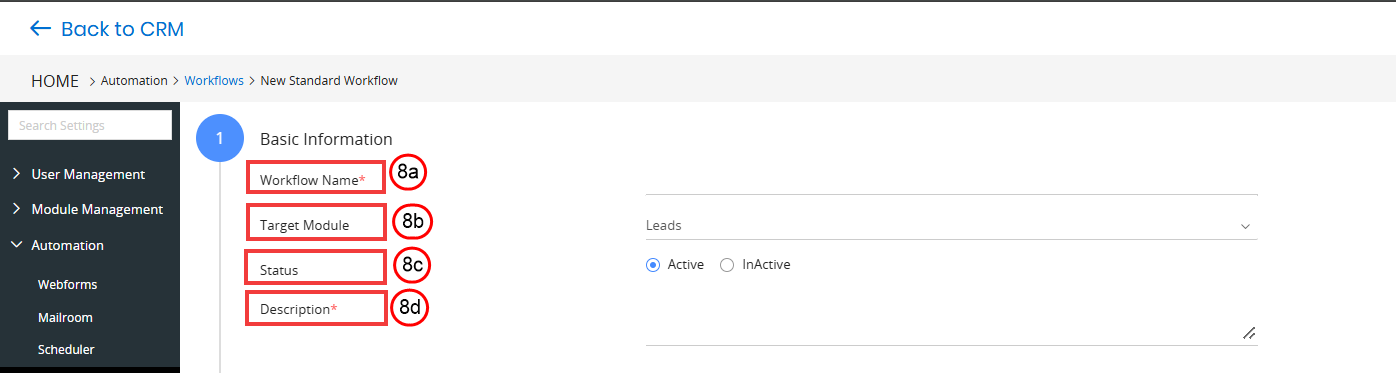
- Enter or select the following details:
- Workflow name: Enter the workflow name. For this example, enter Send Mail Based on Lead Source.
- Target module: Select Leads as the target module.
- Status: Set the status to Active.
- Description: Enter a description that explains the purpose of the workflow action. For example: Automatically send a thank-you email to leads generated through the website
Step 3: Selecting the Workflow Trigger
The workflow trigger determines when Vtiger CRM should evaluate the workflow. For this example, configure the workflow to run when a lead is created.
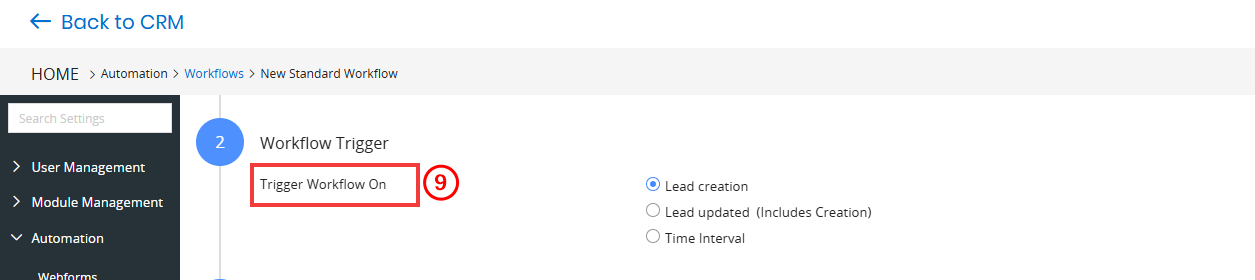
- Select the Workflow Trigger - Lead creation.
Step 4: Setting Up the Workflow Entry Criteria
Entry criteria specify which records qualify for the workflow. In this example, the workflow should send an email only when the lead's source is Website.
- Click the +Add Condition button.
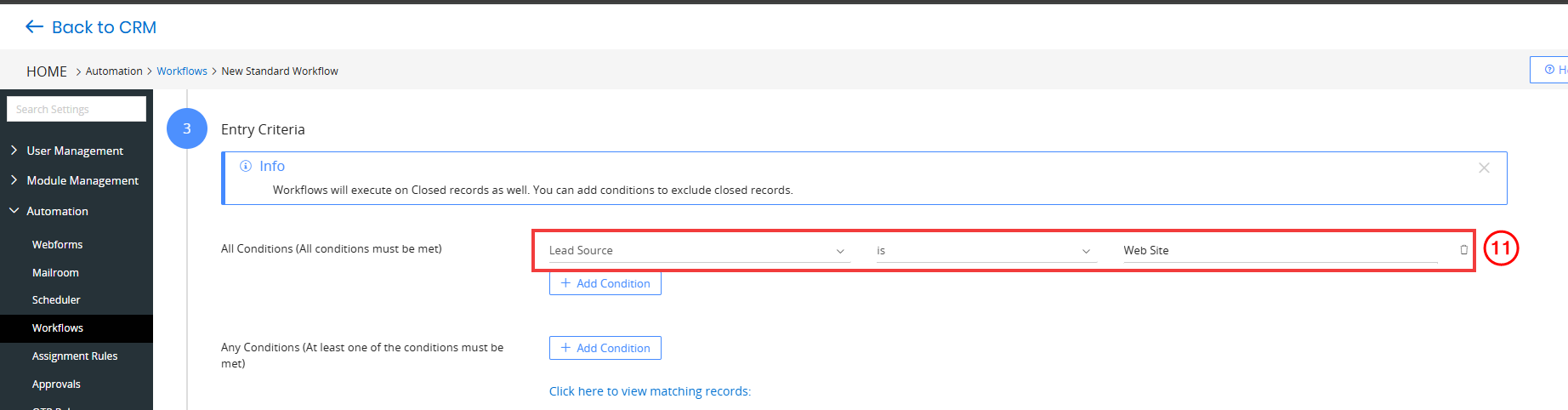
- Follow the steps below to add the condition: Lead Source is Website.
- Select Lead Source from the first drop-down and is from the second.
- Click on the text area on the right.
- Select Raw text from the drop-down.
- Click on Select an option.
- Choose Website.
- Click Save.
The workflow now applies to newly created leads whose Lead Source is Website.
Step 5: Setting Up the Send Mail Action
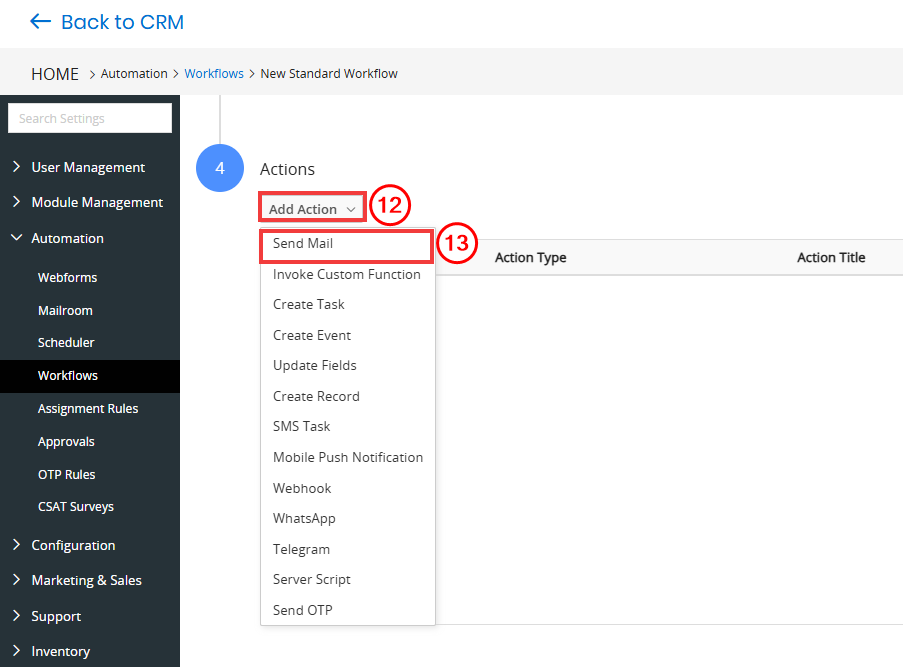
- Click the Add Action drop-down.
- Select Send Mail. An Add Action for Workflow window opens.
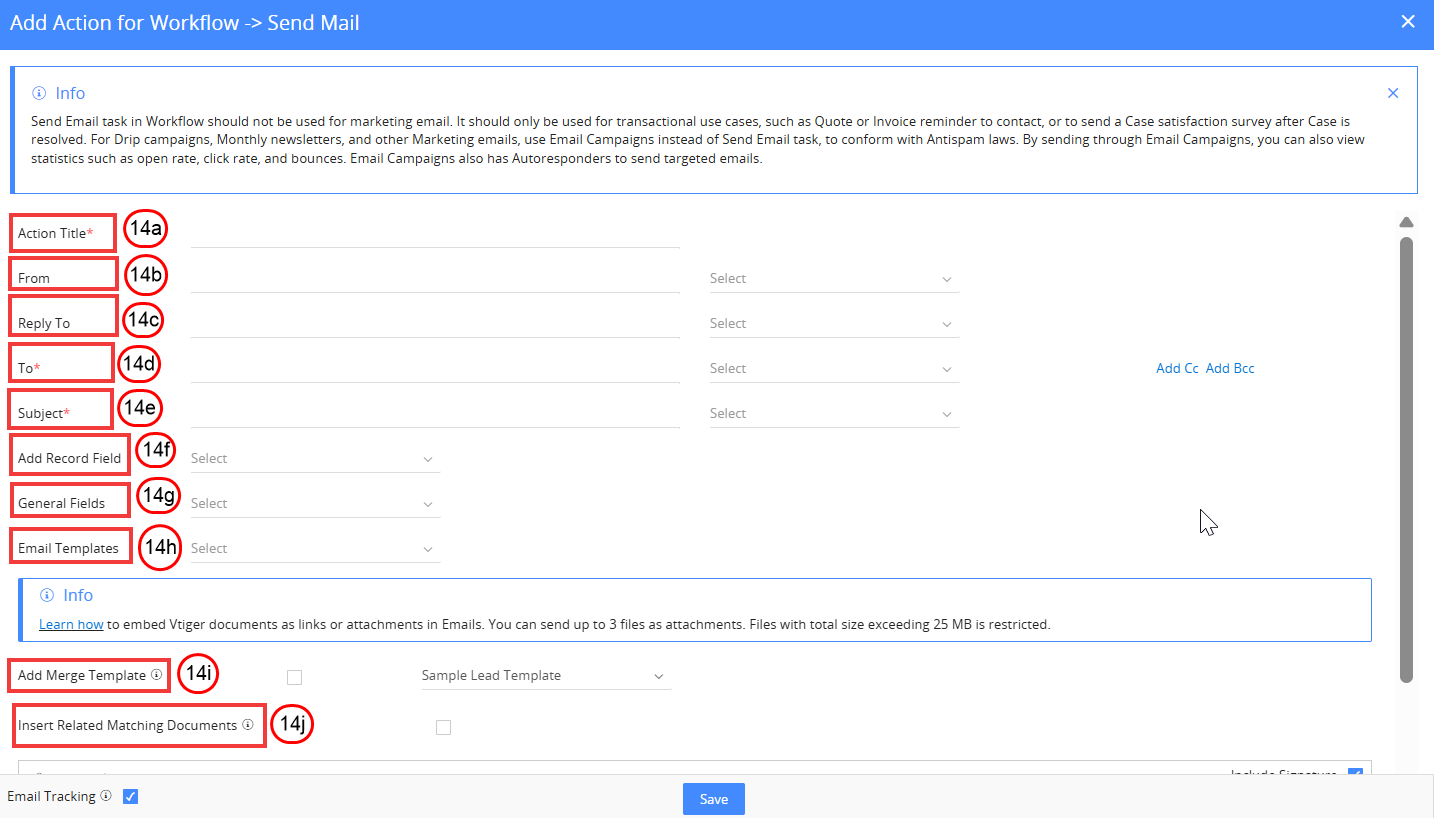
- Enter or select the following information:
- Action Title: Enter a title that identifies the purpose of the action. For example, Send Thank-You Email.
- From: Select the email address from the following options that should appear as the sender.
- Enter a From Email Address: Enter the email address you want to use as the sender.
- Helpdesk Support Email ID: Use the helpdesk support email address configured under Settings > Configuration > Email Settings as the Helpdesk Email.
- Assigned To: Use the primary email address of the user assigned to the record.
- Last Modified By: Use the primary email address of the user who last modified the record.
- Created By: Use the primary email address of the user who created the record.
- Reply To: Specify the email address to which replies should be directed. The options listed in the source include:
- Enter a From Email Address: Enter the email address to use for replies.
- Helpdesk Support Email ID: Use the configured helpdesk support email address.
- Assigned To: Use the email address of the user assigned to the record.
- Last Modified By: Use the email address of the user who last modified the record.
- Created By: Use the email address of the user who created the record.
- To: Select the email recipient from the following:
- Primary Email: The record's primary email address.
- Secondary Email: The record's secondary email address.
- Assigned To: Username: The username of the user assigned to the record.
- Assigned To: Primary Email: The primary email address of the assigned user.
- Assigned To: Secondary Email: The secondary email address of the assigned user.
- Assigned To: Other Email: The other email address of the assigned user.
- Last Modified By: Username: The username of the user who last modified the record.
- For this example, select the lead's Primary Email so that the thank-you email is sent to the lead.
- Subject: Enter the subject of the email.
- Use the available record-field dropdown to insert fields into the subject if required.
- Add Record Field: Select the field you want to insert into the email body.
- For the Leads module, fields such as Last Name and Primary Email can be used to personalize the message.
- General Fields: Select the required field to include it in the email body.
- Email Templates: Use the available email template options to include predefined email content in the workflow email.
- Add Merge Template: Enable the Add Merge Template checkbox.
- Choose whether to include the template As a link or As an attachment.
- Insert Related Matching Documents: Enable and configure the conditions that identify the document to include.
- For example, specify a condition where the document title equals Thank you note for leads.
- Text Box: Use the text box or rich text editor to compose the email body.
- Insert Link: The Insert Links dropdown provides the following options:
- Insert Appointment Link: Insert an appointment link into the email.
- Insert Survey Link: Insert a survey link into the email.
- Insert Document Links: Insert document links into the email.
- Attach Files: Attach files to the email.
- A maximum of 3 files can be attached.
- The total attachment size must not exceed 25 MB.
- Include Signature: Enable to include the Signature in the mail.
- Signatures are configured under My Preferences. Set up the required signature there before inserting it into a workflow email.
- Email Tracking: Enable to get notification when recipients open an email.
- Click Save to save the Send Mail action.
- Click Save to save the workflow.
The email is sent automatically when the configured conditions are met.