Articles in this section
Authenticate Emails with SPF, DKIM, and SenderID Auto forward your emails to Vtiger Managing User Profiles Automate Outgoing Emails in Email Settings Automation - Assignment Rules Set up Multi-path Workflows Creating a Scheduled Workflow Automation - Workflow Scheduler Workflows in Vtiger CRM Vtiger Webforms Set up a Workflow Action to Create Event Set up a Workflow Action to Create Records Set up a Workflow Action to Create Task Set up a Workflow Action to Invoke Custom Function Set up a Workflow Action to Create an SMS Task Setting Up a Workflow Action to Send Emails Workflow Action to Update Fields Automation - Webhook Workflow Automation - Expressions Workflow Configuring Business Hours Configuration - Company Details Configuration - Consents Configuring the Customer Portal Maps in Vtiger CRM Configuration - Usage Details Configuring Encrypted Data Fields in Vtiger CRM Configure Picklist Dependencies Considerations for Deactivating Vtiger Users Configuring Field and Record Displays Create Reminders for Records and Inbox Create a field of a Grid type Dealing with Currencies and Taxes Enable Desktop Notifications on Chrome Web Browsers Vtiger CRM Add-ons IMAP Configuration - 2-way sync between Vtiger and IMAP providers Setting up Autopay & Payment Gateways Inventory - Tax Management Inventory - Terms and Conditions Login to Vtiger on SSO SAML using ADFS Mailroom Functionality for Different Scenarios Manage Multiple Currencies Marketing and Sales - Deal to Project Mapping Lead Conversion Data Mapping Marketing and Sales - Profile Scoring Configuring Module Numbering Configure My Preferences Feature My Preferences - Calendar Settings Tags in Vtiger My Preferences - Notification Preferences SAML Support in Vtiger CRM Vtiger Mailroom Settings - Create Dynamic Fields and Layouts Configuring a Relationship Between Modules Settings - Customize Records and Fields for your Business Settings - Left Menu Settings - Manage Global Picklists in Vtiger Settings - Set up your Support Team Settings - Start Up Page Settings - Working with Picklist Values Configuring Modules Using Module Builder SLA Policies in Vtiger Troubleshooting Login Issues Add-Edit Unsubscribe Links in your Email Template User Management - Authentication User Management - Encrypted Field Access Logs User Management - Groups User Management - Login History User Management - Profiles User Management - Roles User Management - Settings Log User Management - Sharing Rules User Management - Users User Management - Vtiger Support Access Vtiger Buzz - Chrome Extension for Notifications Vtiger Implementation wizard Vtiger Language Support Configuring Websense Trackers Vtiger Websense Widgets Configuring App Passwords for Gmail Outgoing Server and Yahoo Mail Customizing Module Layouts Configuring Module Layouts & Fields Adding Custom Module Auto forward Emails from Microsoft Office 365 Automation - SMS Reply Actions Duplicate Record Prevention in Vtiger CRM Generate and Manage Third-party App Passwords in Yahoo Configuration - Storage Guard Customizing your Self-Service Portal Theme Using CSS Styles Adding Hidden Fields to a Webform Configuring Dependent Fields and Blocks for Modules Login Page Customization Formula Fields Creating Custom Filters Adding a local DNS Entry

Using the Module Label Editor

This article will help you rename all the field and label names in Vtiger CRM.
R
Rashmi Kashyap
4 Feb, 2026 - Updated  2 days ago

Feature Availability

Vtiger Editions: One Pilot | One Growth One Professional | One Enterprise | One AI

Introduction

Vtiger Labels Editor feature lets you modify the names of CRM modules, fields, and other interface elements to create a system that feels uniquely yours.
Whether you serve Consumers, Students, or Patients, the Labels Editor allows you to adapt the CRM’s terminology to fit your business model perfectly. By renaming modules and field labels, your team can work in a familiar environment that reflects your organization’s specific language, improving comfort, clarity, and adoption.
Note: Only Admin users can make changes to the names of modules, fields, etc., unless a CRM user is given this right.

Benefits

The benefits of using the Labels Editor feature are:

  • Streamlined User Interface - Streamlines the user interface, making it more intuitive and user-friendly.
  • Flexibility - Provides the flexibility to adapt labels to new business processes, departments, or products.
  • Field Customization - Allows you to customize the labels of fields used to capture and store information. You can rename or modify the labels of existing fields or create new custom fields with labels of your choice.
  • Module Customization - Helps you organize different aspects of customer relationship management.

Key Terminology

Key Term

Definition

Labels Editor

Let's you rename module, field, and interface labels to match organizational terminology.

US English Label

The standard CRM label text is displayed in the U.S. English language setting.

Default Label

The CRM’s pre-set label name is based on the selected language.

Custom Label

The user-defined label that replaces the default label in the CRM interface.


In this article, you will learn about editing label names. Label Names

Editing Label Names

Editing field or label names is an effortless task in Vtiger CRM. All you have to do is find the label and rename it!

Follow these steps to edit label names:

  1. Log in to your CRM account.
  2. Go to the main Menu.
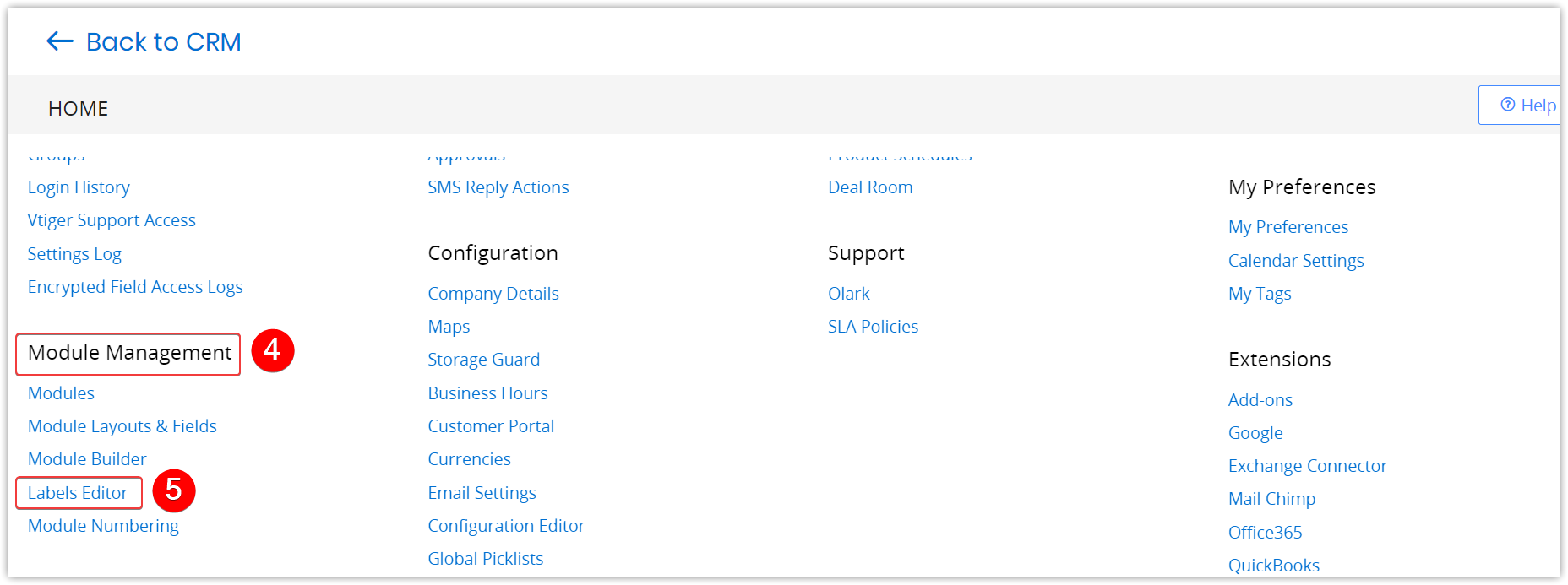
  3. Click Settings.
  1. Look for the Module Management tab.
  2. Click Labels Editor. The screen displays default names for all the labels provided by Vtiger CRM.
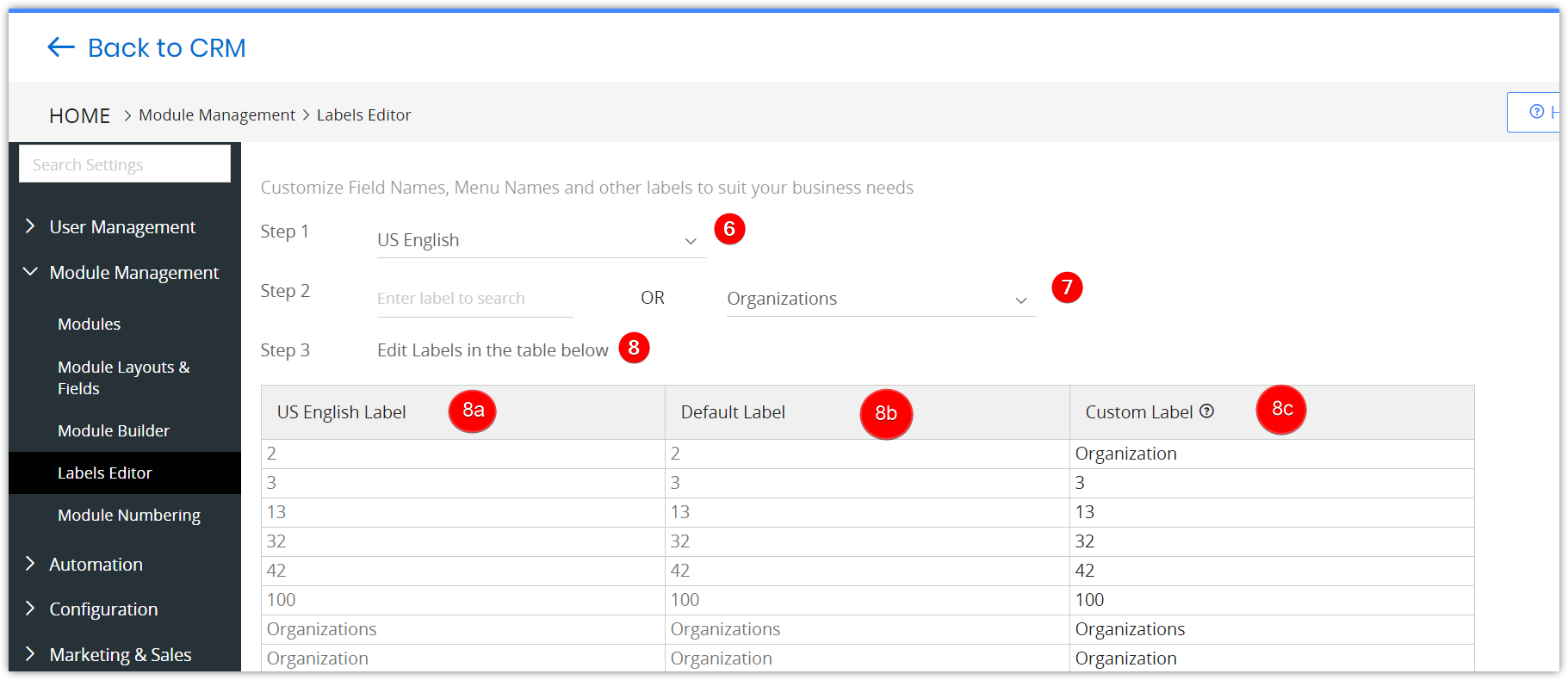
  1. Enter or select the following information:
    1. Step 1 - Select the language in the Step 1 drop-down.
    2. Step 2 - Enter the label name to search the CRM or select the module in the Step 2 drop-down. 
    3. Step 3 - Edit the Custom Label column in the table under Step 3. Each column has its significance:
      1. US English Label - This is the standard column for all the labels.
      2. Default Label -This column displays all the labels based on the language selected in Step 1.
      3. Custom Label - This column enables you to customize the label names.

All the edits you make will be auto-saved in the CRM.
 

Note:

  • Field values should not be empty in the Custom Label column.
  • If you do not find a label under the specific module, then go back to Step 2 and enter the label you want to rename and save.
  • Changes made for labels in one language will not reflect on the others. You must change the label names individually for each language.
  • For example, labels for US English and British English are different; if you have changed to US English, you may want to change to British English by changing the language in Step 1.

Related articles
Configuring Module Numbering Duplicate Record Prevention in Vtiger CRM AI Widgets in Vtiger CRM
Home Privacy Policy Terms of Service Security Center Policy & Legal Center Contact Us
© Copyright 2025 Vtiger. All rights reserved.
Powered by Vtiger
Facebook Twitter Linkedin Youtube