Articles in this section
IMAP Configuration - 2-way sync between Vtiger and IMAP providers
Feature Availability
Vtiger Editions: One Growth | One Professional | One Enterprise | One AI
Introduction
Two-way sync keeps emails in sync between Vtiger and your email provider (IMAP). This means any email you send or receive, whether from Vtiger or from your regular email app, will appear in both places.
You can reply to customers from Vtiger or directly from your email inbox, and all conversations remain up to date and organized in Vtiger. This helps you keep a complete email history without missing any messages.
Benefits
The benefits of 2-way sync between Vtiger and IMAP Provider are:
- Emails stay in sync everywhere: Emails sent or received in Vtiger also appear in your email inbox (Gmail, Outlook, etc.), and vice versa.
- No missing conversations: You can reply from Vtiger or your email client without losing the email history.
- Better context for teams: Everyone can see complete email conversations linked to contacts, deals, or cases.
- Save time: No need to forward or manually copy emails into the CRM.
- Improved collaboration: Team members can view customer email communication in one place.
- Consistent records: All customer interactions are automatically updated and organized.
In this article, you will learn about:
- Setting up the Mailbox
- Mailbox settings
- Email Sync Behavior
- Limitations
Key Terminology
|
|
|
|
|
|
|
|
|
|
|
|
|
|
|
|
|
|
Setting up My Mailbox
Note: If you have already configured My Mailbox in your Inbox, please delete your mailbox to set up a 2-way sync.
Step 1: Set up My Mailbox with a 2-way sync
Follow the steps below to set up My Mailbox with a 2-way sync:
- Log in to the CRM.
- Click the Inbox icon in the top-right corner of the screen.
- Click the Setup My Mailbox button.
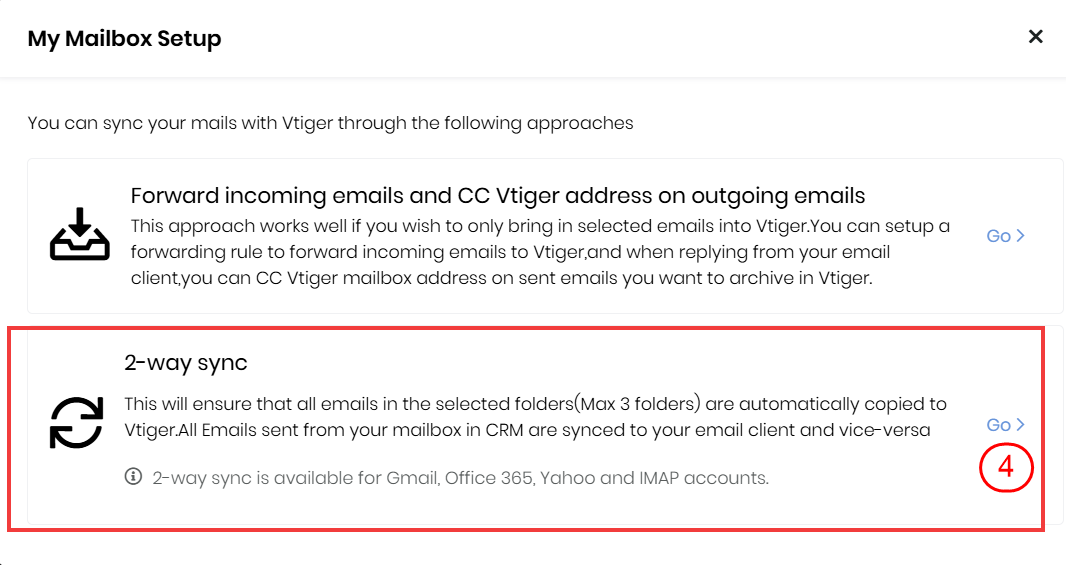
- Click Go on the 2-way sync tab.
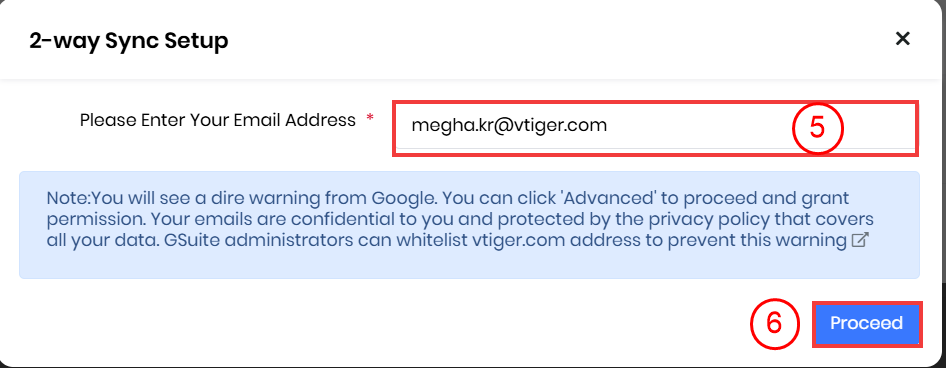
- Enter the email address.
- Click Proceed.
- Sign in to your account.
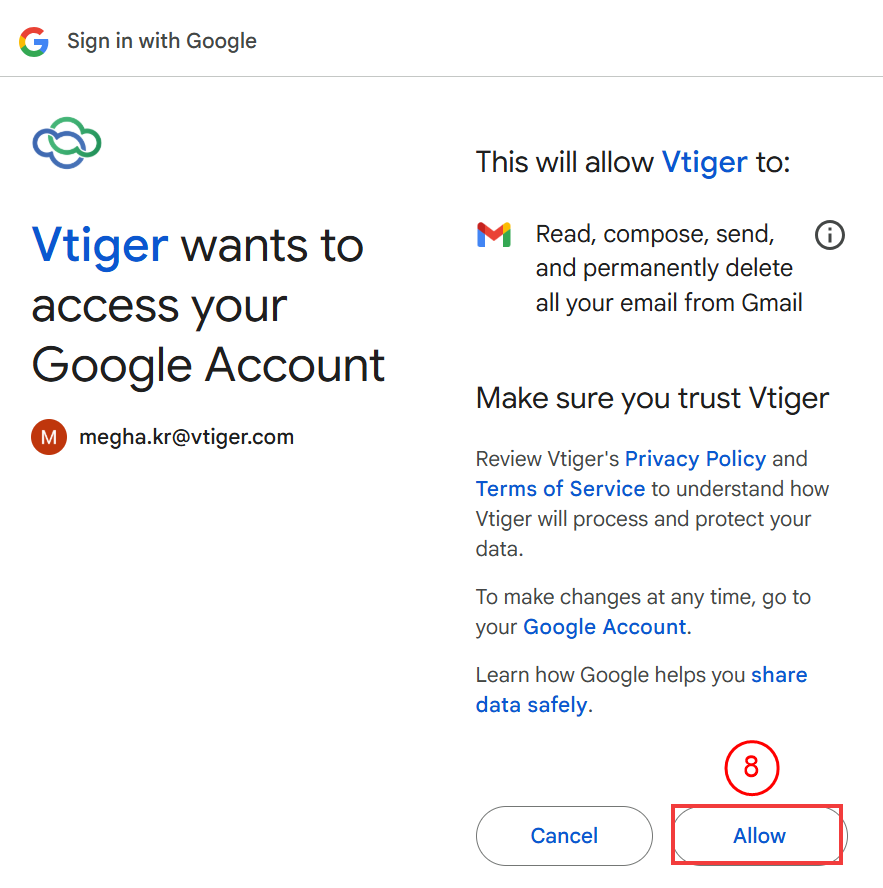
- Click Allow.
Step 2: Setting up Folders
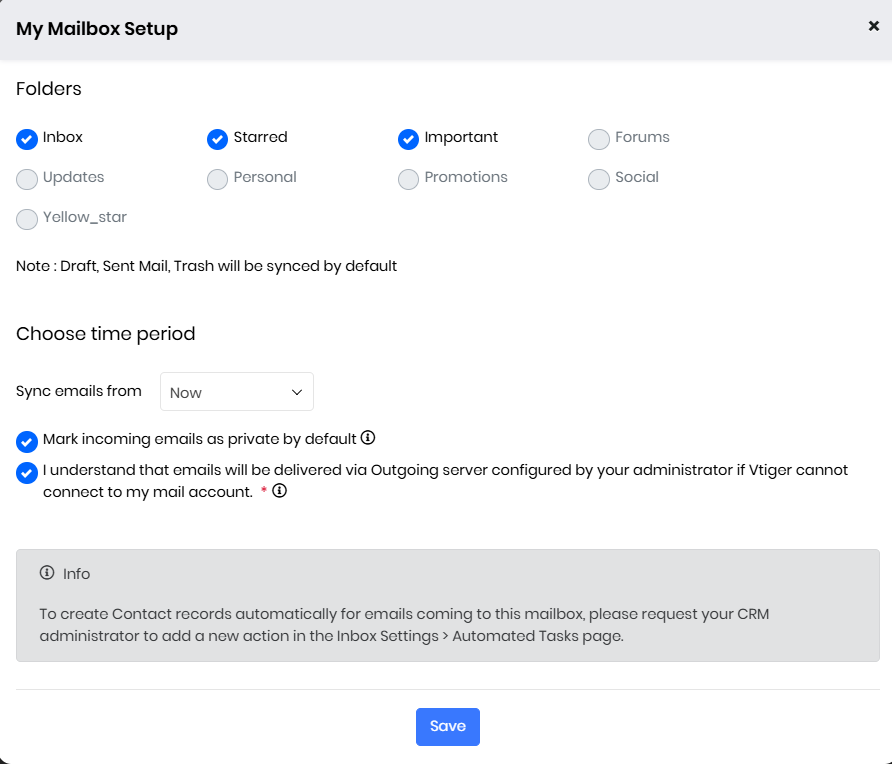
Once your mailbox is connected, you can customize how emails are synced and managed in My Mailbox using the following options:
- Select folders to sync: Choose the email folders you want to sync and view in My Mailbox.
- Choose the email sync period: Decide how far back emails should be synced:
- Now – Sync emails starting from the current time.
- 1 month ago – Sync emails received from the past month.
- 3 months ago – Sync emails received from the past three months.
- 6 months ago – Sync emails received from the past six months.
- Mark incoming emails as private: Enable this option to automatically mark all incoming emails as private by default.
- Provide consent: Enable the checkbox to confirm that you understand emails will be sent using the outgoing mail server configured by your administrator if Vtiger is unable to connect to your mail account.
- Save settings: Click Save to apply your selected preferences and start syncing emails.
Note:
- You cannot edit the selected period once you create the mailbox.
- The Archive and Create option works only for past emails during the 1st-time sync.
- For new emails, you need to add mailroom actions to archive and create.
Mailbox Settings
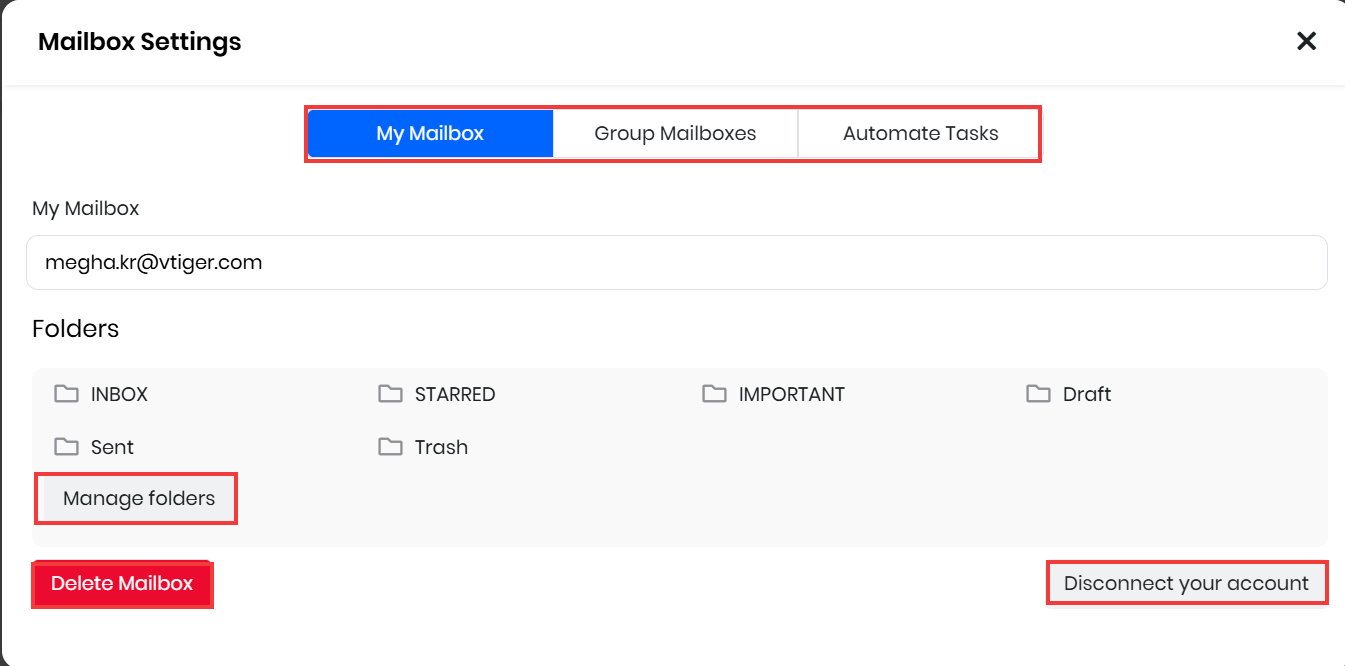
You can manage your mailbox preferences and email connections from the Mailbox Settings section under My Mailbox using the following options:
- Switch between My Mailbox, Group Mailbox, and Automate Tasks by clicking the respective tabs.
- Click Manage Folders to enable or disable additional email folders for syncing.
- Select Delete Mailbox to permanently remove My Mailbox from Vtiger.
- Click Disconnect My Account to stop the email sync between Gmail (or your email provider) and Vtiger without deleting the mailbox setup.
My Mailbox View
In My Mailbox, folders from your email service provider are synced and displayed under the Open folder in Vtiger. This allows you to manage emails directly from the CRM while keeping them in sync with your email client.
Email Sync Behavior
The following outlines key behaviors and restrictions related to email synchronization:
- Draft emails created in Vtiger that contain links or merge tags appear in the Drafts folder of your email client after syncing. However, these links and merge tags do not function within the email client.
- Comments added to emails in Vtiger are not reflected in the email client.
- Touchpoints and email engagement details are automatically updated.
- When composing an email from the Inbox, the My Mailbox email address is automatically selected in the From field.
- Email queuing is disabled, so emails are sent immediately.
- Emails sent via Workflows (Send Email action), Case Replies, and Internal Tickets are automatically linked to the Sent folder.
- The option to move emails into My Mailbox is restricted.
Here’s how common email actions like drafting, attachments, signatures, and deletions behave in My Mailbox.
Drafting Emails with Inline Images
- Draft an email with an inline image in your email client.
- Modify and save the draft in the email client.
- When you open the same draft in Vtiger, the inline image appears as an attachment instead of being embedded in the email body.
Email Signature Behavior
- Enable the Include Signature option in Vtiger.
- Draft an email from your email client.
- When the draft is opened in Vtiger, the email signature is not included.
Attachments and Size Limits
-
If you send an email from Vtiger with an attachment that exceeds the email client's maximum size, you receive a bounce notification.
Deleting and Restoring Emails
- By default, emails in the Trash folder are not synced during the initial sync.
- Permanent deletion of an email is synchronized between Vtiger and the email client.
- If a draft is deleted in the email client and later opened in Vtiger, you are prompted to restore the email before viewing it.
Limitations
The following are the key limitations when using two-way sync with your email client:
- Folders from your IMAP email client are not displayed in the CRM
- Any custom folders you have created in your email client (like Gmail, Outlook, or other IMAP providers) will not appear in Vtiger. Only the main synced folders, such as Inbox, Sent, and Drafts, are visible and accessible in the CRM.
- Users cannot access or manage emails from these custom folders within Vtiger.
- Draft emails created in Office 365 do not sync to Vtiger
- If you create a draft email in Office 365, it will not appear in the Vtiger CRM Inbox. This means you cannot continue editing or send these drafts from Vtiger; they exist only in Office 365.
- Users must either compose the email directly in Vtiger or recreate the draft within Vtiger to send it from the CRM.
- Emails drafted in folders other than the main mailbox in your email client do not sync to the CRM
- If you save draft emails in any folder other than your primary mailbox (for example, a subfolder under Drafts), these drafts will not sync to Vtiger.
- Vtiger only tracks drafts saved in the main mailbox, so to ensure your drafts are available in the CRM, always save them in the main Drafts folder.
Reference
- Vtiger Inbox
- Create Reminders for Records and Inbox
- 2-way Sync with Yahoo
- Auto-forward your emails to Vtiger
- Automate Outgoing Emails in Email Settings
- Email Feature User Guide
.